
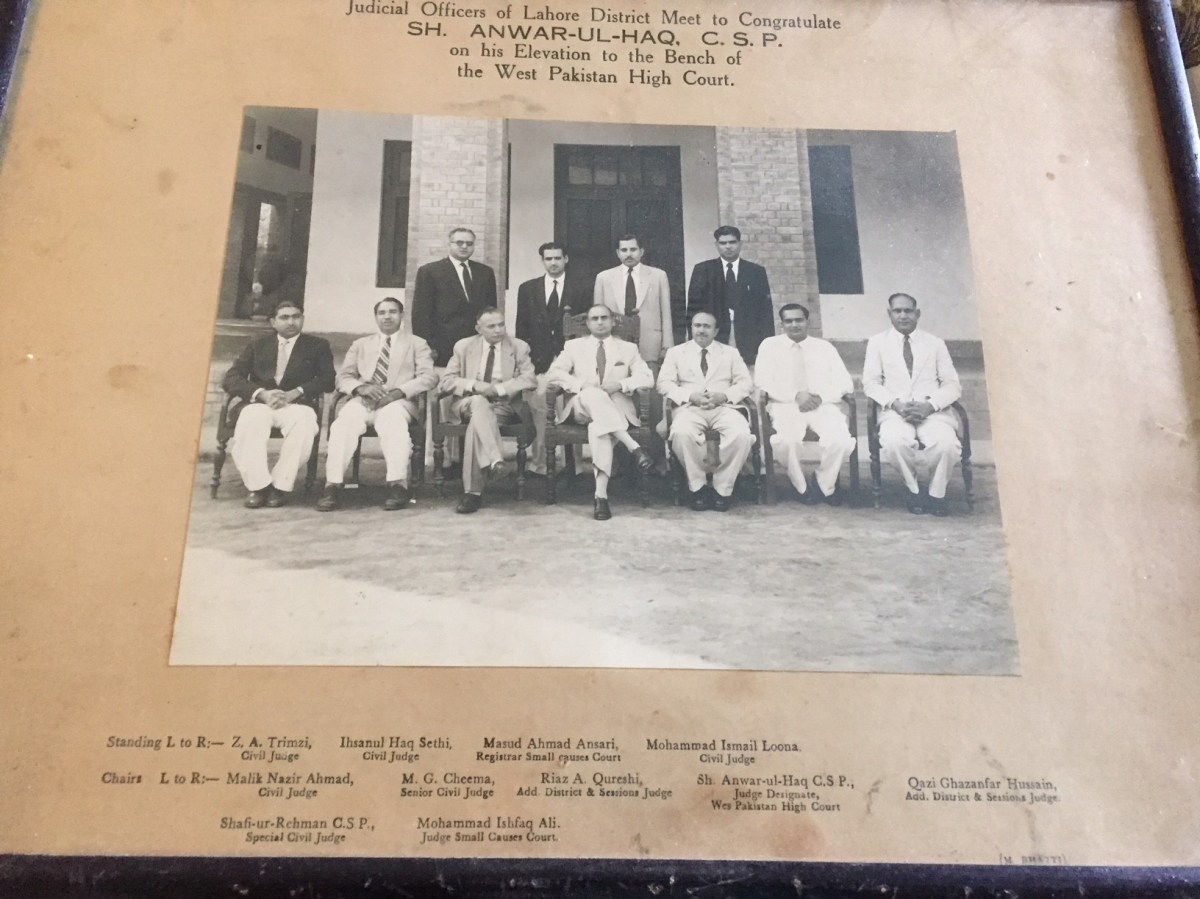
Induction
I called on the Chief Secretary and requested for release from Executive Service. He readily agreed and was generous to grant me the same terms and conditions as I was enjoying as Deputy Secretary in the Secretariat. Next, I called on the Chief Justice M. R. Kayani. He too was kind and agreed to have me in the judiciary. He made three remarks, and nobody will believe, I did not understand their full implication throughout my entire service of 43 years. He asked me whether I have Bengali blood. I said no. About himself, he said, “I was forced to come to the executive, I have forgiven the executive for that but—“. He did not complete this sentence. I kept on guessing. Then he asked me to ask my other colleagues in the executive to come over to the judiciary because in future it will become difficult for them to come over.
I did not then understand the full implication of this remark. I guessed, only a guess, that he thought that all officers of ICS/CSP (Indian Civil Service / Civil Services of Pakistan) are dumped into judiciary against their will. Here is a volunteer who is himself taking on a burden the dimensions of which he does not know. Only an example, just as God called the man a “fool and ignorant’ when man accepted to be God’s naib (vice) on Earth (khalifatul arz) [Sura Al-Ahzab 33:72].
The Chief justice took me under his protective cover, became a mentor of a different type. But only till 1962 or so when he expired. He allowed me to talk to him somewhat freely when I became Registrar of the High Court. None in the office dared to appear before him, making any suggestion was totally out of the question.
One Years Training in Lahore
I was given an order appointing me Special Civil Judge in September 1958. The powers conferred were of Special Civil Judge Third Class. The third class made no difference. Most of the third-class suits were declaratory in nature raising very intricate questions of law. Nine law books were prescribed, all relating to civil law and practice and further, I was required to keep twenty criminal cases all the time on my file.
Surprisingly, within days of my taking over in the Judiciary, Martial Law was declared, this time in the whole country. Three of my very seniors in the Executive, individually and separately, told me that I would have not gone to the judiciary had I known that Martial Law was coming so soon. I kept quiet, giving them the impression that they were right.
The news that started coming from my colleagues on the Executive branch was alarming. Out of the three who saw security in Martial law, one was sentenced to imprisonment, the other two removed from service. M. A. K. Chaudhry in his “Of All Those Years” (page 50) writes:
“Marked politicians and bureaucrats were picked up, detained, removed from service, or sentenced to various terms of imprisonment without due process of law”
Ralph Braibanti in his book Chief Justice Cornelius of Pakistan mentions 1662 Central Government officers were screened out. In his other book “Bureaucracy in Pakistan” he mentions action was taken against 3549 public servants (page 293).
Called a Foolish Judge
Within two months of the imposition of Martial law, we were all asked to assemble in the chamber of the District and Sessions Judge, over twenty of us. The Sub-Martial Law Administrator in full uniform addressed us how we should be doing our work and at almost at the end, he said “I do not know who was that foolish judge who passed a stay order directing me not to distribute the prizes at the end of the football match. There would have been law and order problem if I had obeyed the order, so I distributed it.” I did not know, nor then cared to know, who that foolish judge was. I am sure everyone else came to know it within minutes. Within two months thereafter the District and Sessions judge called me and asked me to withdraw the contempt case. I said I have not started any contempt case. He said that there is one pending in your court against the former Sub-Martial Law Administrator. I told him that if a party has started it I am not going to do anything about it. The case was transferred from my file as was the Sub-Martial Law Administrator from his post. I still do not know whether on account of my foolishness or that of his. What kept me worrying was that over a hundred years ago, at the apex of its power, a British High Court Judge had appeared in the court of a Magistrate to receive the sentence of fine. More surprising, that Magistrate of a very humble beginning was to become the first Indian Chief Justice of an Indian High Court, the only one in the world whose statue has been placed in the precincts of that High Court. Our army man wriggled out successfully from facing contempt proceedings, and there telling me all about how to run the country and the rioting that was likely to take place if he had conducted himself otherwise.
Shocking for me
Within months of my training, I saw on my file a case which greatly shocked and surprised me. A lady about 18 years of age was suing her husband, close relative of hers, one teacher of English in a college and the wife a student of Masters in English.
Her claim was that her husband had delegated the power to divorce and she had exercised that power and had ceased to be his wife. The file had become bulky because all the correspondence between the spouses used to take place in English and those letters formed the evidence in the case. The case was pending for about four years, the last eight months Order Sheet read “The lawyers are present. They are not prepared to argue the case. Adjourned.”.
I gave the lawyers a week time to prepare the case to their satisfaction. They argued, the declaration was granted. Within two months the appeal filed was dismissed. A few months thereafter a photograph of married couples was published in a prestigious magazine “Mirror”, said to be first Asian Magazine, then published all on Art paper. Its publisher happened to be my college days successful competitor of story writing, Zaibunissa, added to her name was Hamidullah. In that magazine, I saw a photograph of a couple. I recognized the husband because he was pursuing the case of the lady for a declaration, whom he had married. I had then a feeling of uncertainty how their marriage would proceed after such a long court ordeal. About forty-five years, long after my retirement, we came across at the entrance of a hotel, recognizing me he greeted me. My only question to him was how the family is. He informed me that his daughters were medical graduate specialists posted in various hospitals. I heaved a sigh of great relief.
Guided Studies
I called on the Chief Justice to report about the progress and to make a request. He asked me whether I had read all the books; my reply was yes. He asked whether I had read Brooms Legal Maxims as well. I said yes. He said – “Look, this book has to be read most of the time, even today we consult it”. I got the book and even now look at it from outside in remembrance of the Chief Justice. Our most successful Chief Justice used to occasionally refer to Mejelle, the Turkish compilation of Islamic law. So I got a copy of it. There was another reason also.
In the Public Service Commission interview, I was asked two questions which I still remember. The first was about the importance of Bahrain. The word Bahrain appeared so appealing to me that I had read all about it. So, my answer was to their satisfaction. The next question was what the law is applicable in Turkey and Egypt. I did not know a word of it. We had been taught Hindu law, Muslim law, Roman law and Anglo-Saxon law. It is very comforting and enlightening that now knowledge is very quickly becoming global, the internet playing such a vital role in it, Facebook giving yet another dimension to freedom of speech. My request to the Chief Justice was to relieve me of the duty of having 20 criminal cases on my file all the time as I had dealt with such cases most of the time while in the executive. The Chief Justice denied that request saying you should be doing both types of cases at the same time.
Posting as Senior Civil Judge, Montgomery (now Sahiwal) for Six Months
This posting was a part of eighteen months of training. The house allotted to me was a newly constructed one, small but compact, for a bachelor, luxury. Across the road was the club. At walking distance, one may say next door, was the Court. The best area at that time there was the Irrigation Officers residences and their club. A college building had just been completed, very good to look at. Surprisingly, there was no provision for a library therein. The Court cases were of a different type, rural mix. Colony cases, preemption cases, over twenty registers for checking. The more neglected side of work was the execution of decrees, the management of minor’s property and dealing with their assets. There, over twenty registers, four or five key ones to be taken care of. A colleague of mine, a year junior to me, was posted there as Deputy Commissioner. In that capacity, he had got for his car registration No. 1 MY (for Montgomery – now Sahiwal). Fifteen years later, when he was Commissioner, he told me that he was getting twenty-five thousand rupees for getting that number transferred to someone. I told him that I have never been in that business and did not know the rates. Recently I read in the newspaper that No.1 of Chakwal was auctioned for Rupees Twenty lacs. What an untapped source of legal income for impoverished departments.
Posting as Additional Sessions Judge Lahore
Having completed eighteen months training I was appointed to a senior post of Additional District and Sessions Judge. It was a set routine work, trying criminal cases punishable with death, hearing of criminal and civil appeals, all in an effort to reach the target of 60 or 75 units which was the required standard of disposal. After a few months I was posted as Registrar of the High Court.
Posting as Registrar High Court West Pakistan
This posting appeared to me to be very challenging, dealing with over fifteen judges of the High Court, when I had not till then dealt with more than one. Fortunately, M. R. Kayani was the Chief Justice. About judges, I had read that they are not supposed to socialize much. Many reasons were given for this but the one that I found interesting was that then the people would come to know that the judges have also feet of clay as anyone else. Unfortunately, that was exactly my experience. On my taking over I found a crisis. At that time the judges had a fixed limit on the use of official telephone. The excess was payable by the judges. In the US, it is called the co-pay system, very good to keep not only the elders but also the children under the discipline of a sort. The judges were not informed of it by their own office. Half the judges were ready to pay the excess, others were not willing to pay saying that they were not kept informed. I was asked to attend a meeting in the Secretariat to resolve the matter. There were three officers, each of them three to four years senior to me. After a cup of tea, they asked me what to do. I asked them they should tell me what would satisfy them. They said if I take the responsibility of observing the rule they will be satisfied. That was settled. I came back informed the Chief Justice and then wrote a letter to the two Additional Registrars, Peshawar and Karachi, asking them only to satisfy the requirement of the rule on my behalf. Within two months or so a full court meeting was held at Lahore. The Judges from Karachi protested loudly and seriously about my letter to the Additional Registrar treating it as spying on their telephone call etc. I remained quiet, so did the Chief Justice. What followed after the meeting, and elsewhere, I do not know.
The other problem concerned the ‘readers’ of the Court. An order of the Chief Justice passed years back was treated as requiring the readers to pass all the nine papers in one go and not separately one or two papers at a time. After discharging full duty in Court how could they do it, none so cleared all the papers. None was appointed permanently as Reader, none got the full pay of the post, and none could look forward to promotion. Realizing this I wrote a note and pointed out the unreasonableness and the hardship of the requirement. The only order Chief Justice passed on it was “I never intended it so.” I took it as the retrospective approval of my proposal and within days made all of them permanent as they had already passed it in singles.
At that time the High Court followed one good practice with regard to District Court Judges. The normal period of posting at one station was three years synchronizing with the educational year. The judges were required to give three stations of their choice for their next posting. It happened to be Registrar’s duty to adjust them accordingly, or with consultation, as best as could be done.
Land Grants to the Meritorious Officers
A scheme of land grants to the meritorious officers was launched by Gen Mohammad Ayub Khan. Only one judge of High Court, from Karachi, refused to look at it saying it was not a part of conditions of our office when we took over. A few land grants in Guddu Barrage were availed of by other judges. The Chief Justice in one of the meetings informed that the General had remarked that not a single officer at the District Judiciary level had an above average record. The Chief Justice said that the General does not know that we give above average remark only when we propose to elevate the judge to the High Court. Addressing the Karachi Bar Association, the Chief Justice made the following remarks (7th November 1962)
“But this I must say now, that the legal system has become directly and profoundly demoralized by the fact that the Law Secretariat was taking advantage of the prejudice which naturally exists in military circles in respect of the ordinary law and was widening the gulf further between the Government and the High Court.”
And he said further in the same speech;
“Of course, I took a very serious view of the provision made within two months of martial law for the suspension of judges. I regarded it as a “cold insult” to me as Chief Justice and I promised never to forget it. I haven’t forgotten it. I said in the highest quarters that no other Government could have been persuaded to make that revolutionary provision. It has demoralized the High Court”
Towards the end of the first Martial law with an eminent lawyer as Law Minister, a system of a formal interview by the President of those recommended for appointment as a judge of High Court was devised. Another eminent lawyer, Hamid Khan, made the following observation at the SAARC Law Conference at Karachi from 3-5 October 1997.
“The rot started, in particular, during the regime of President Ayub Khan. He made a number of judicial appointments on political or personal considerations. He made an appointment to the High Court of a Member of the National Assembly in return for his vote on a matter, which was highly sensitive for the government in power. He appointed a brother of a prominent politician, who helped him in the Presidential election of 1965 as a judge of West Pakistan High Court. Another judge was appointed by President Ayub on the recommendation of his Pir. He used to hold interviews for the recommended which perverted the system making it highly arbitrary and subjective.”
Within a few months, I was transferred and posted as District and Sessions Judge Abbottabad, a prized station of Posting.
Posting as District and Sessions Judge Abbottabad (1961 to 1963)
As I was married the same month, my colleagues thought I was given a honeymoon station. They did not know that the Chief Justice was against my taking up two heavy responsibilities at the same time. Abbottabad was the best station in my service career. There was no cold creeping wind at any time of the year, very unlike Islamabad or Mansehra at a short distance from there. There was a peak visible from inside the house as well as from outside which remained covered with snow about thirty feet top from November to February. The Sessions House, as the residence was called, was in the middle, on one side the Circuit House, on the other the Court House, bus stand just across the road, not thickly populated then. The Army Headquarters, the Kakul Academy and the open space around added beauty and order to it. About twenty miles down was Haripur, one of the most fertile areas for growing fruits and vegetable. The pity was that there were no quality fruit plants inside residence enclosures. One of the best Government farms was located at a short distance, at Tarnab. It was unfortunate that the advance research institutions did not reach out to spread good things that they developed or recommended for the region. The result was that only the elite and the knowledgeable people had access to these. The terrain being hilly the land for cultivation was in small plots, at times terraced, very picturesque to look at from a distance.
Immediately after my arrival there, the people who came to meet briefed me about the peculiarities of the people around. Their main thrust was that people were prone to complain, right or wrong. I told them that it was good that they got an opportunity to express their grievances and get the correct information. In order to impress me further, they used to say that a man going on cycle in the street seeing a shopkeeper writing will shout loud that if it is to a friend convey my greetings if it is a complaint against any officer put my name also. It was interesting to hear that.
From my point of view, the most exceptional feature of litigation there was the privileges and the easement rights of the owner of the higher-level property and that of the lower level property owner. It was a fascinating study for me. The judgment that I wrote got appreciation from a foreign origin Judge of our High Court. It greatly helped me in understanding how China is planning to divert the water from India and how India is attempting to reduce the supplies of Pakistan and how Pakistan is debating still and is involved in blame game what to do, whom to blame, inside the country or outside. That reminds me of what Mark Twain said long ago that “Whisky is for drink and water is for the fight”.
There was not a much serious crime in the district, but petty theft cases were many. In every theft case taking place at night the story was almost the same, that hearing some noise I got up wore my clothes and in dilli light, I identified the culprit who in any case ran away. I could not understand it. I asked the lawyers what it meant, getting up and then wearing the clothes. They informed me that there is a belief that clothes deteriorate most during sleep. It is the practice that before sleep they take of their clothes and then go to sleep. What about dilli? They said it is candle like stick of pine tree. It has turpentine oil in it which keeps burning all night if kept upright. That made sense to me.
The pendency in my Court dropped in about eight months. I was asked to go to Peshawar for a week to attend to their heavy load. That I did for a few months and then I was posted as District and Sessions Judge and the real test of my worth began.
Embarrassments at Abbottabad
No.1 I had a Senior Civil Judge and two civil judges working with me. It so happened that I accepted an appeal in a contempt of Court case and set aside the conviction and sentence. All the three civil judges came together and requested me to stand by the civil judges so that the dignity, respect, and authority of the courts are maintained. As politely as I could, I explained to them that dignity, respect, and authority all come after legality and fairness. Besides, you should not take the reversal of the judgments by the appellate courts so seriously because it is going to happen time and again all your life, where ever you are. I know that to self-centered people such advice does not matter.
No.2. From nowhere a person appeared before me and said that he was a Senior Civil Judge in the province. The Police had challaned him in more than one case in spite of his telling that he was a Senior Civil Judge. I as a brother judge should help him and get the cases canceled. I told him that I cannot do it at all. Greatly disappointed he left.
No.3. Late Mr. KMA Samdani’s Urdu book “Jaeza” 2004 (page 57) While posted as District and Sessions judge Abbottabad, he was informed that a Deputy Secretary of the Law Department of the province will be visiting with family. On arrival, he was entertained well but then he demanded that a vehicle be obtained from some notable so that he can visit places of interest. He was denied that on which he showed his displeasure. His concluding recorded remark is such demands are objectionable even in the executive but are condemnable in the judiciary.
Chief Justice MR Kayani inspects my Court
The Chief Justice’s inspection of my court was my first experience of facing a formal inspection. The first advice the Chief Justice gave me was that I should have called at his residence a day before to ascertain his program. I kept quiet. I had an answer but it was likely to bring about an immediate clash. I had experienced in the executive service that all those to be inspected remained in attendance around the inspecting officers, attending to all their needs. I did not want that judicial officer should fall in the same category. It would have been hard for the Chief justice to condone that a District judge should match his independence and insularity with that of the Chief Justice.
The first question he asked me was whether I had called on the Deputy Commissioner after taking over the charge. I replied that I had. Next, he asked whether the deputy Commissioner had returned the call. I said no. Being an ICS chief he would not have left it at that. But I do not know anything more about it. Next, he guided me on how to deal with the lawyers. He thought I think rightly, that I was somewhat inexperienced in that aspect of my duties.
The Chief justice had one year more to retire. The report that he gave me commenced with the words “I have never been so satisfied with an inspection” and then proceeded to describe the commendable part of what he had found. Nobody outside the judiciary can feel the elation, the confidence and the encouragement that a District Judge would feel on such a comprehensive, close and guided coverage by a Chief Justice. Now those having not experienced it and lured by the luster of executive power, want to substitute it with surprise inspections, easy, subjective superficial, irrelevant for the judiciary.
Long Posting as Divisional Judge Peshawar (1963 to 1967):
The Hardships coming first
I call it Divisional Judge because I had three districts to look after; Peshawar with one Additional Judge, Mardan with one Additional Judge stationed there, Kohat covered for a week from Peshawar by each of us. It made two weeks each month.
On transfer to Peshawar and with the consultation of my predecessor I arrived with bag and baggage. I found that one portion of Sessions House remained in occupation of my predecessor, all the rest taken over by a Director Basic Democracy. Only the verandah of the house was available for me where I dumped my luggage. My wife kept on reminding me of my blunder of opting for the judiciary leaving the executive. The Commissioner had allotted Sessions House to Director Basic Democracies, for considerations floating in the air, none commendable. Personally, this Commissioner commanded my highest respect. His father who remained in Delhi, was a top-class Muslim Leaguer, only next to Quaid e Azam, associated with the creation of Pakistan. His other brother was an ICS, youngest a CSP, my friend, a year senior to me posted in the same Division as DC Dera Ghazi Khan. What hurt me more was that all the four DC level officers, a year or so junior to me, posted in Mardan, Mohmand Agency, Kohat, and Peshawar did not utter a single word of sympathy, not a word against the Commissioner. It appeared they were all in Chains. Our esprit de corp would come to this level, I never thought so. The value in service was substituted by visible merit and obedience. What a fall.
I called on the Commissioner, as required by the protocol. The Commissioner said I can choose any residence he will allot it to me. I replied that I had already reported the matter to the High Court and I will follow their orders in the matter. It took over a month for the Governor to pass an order that designated residences should not be allotted to any other officer. So I got it restored to me. To my knowledge, this was the only house used as Session House since 1880, having the central heating system, provided the Sessions Judge had the resources to purchase the required quantity of steam coal. I had not so I could not avail of it.
The Sessions House was an old building, so it was massive, the rooms extra-large, many servant quarters, Kitchen removed but connected by a convenient corridor. Sometimes snakes were encountered outside, not harming anyone. Inside were the scorpions more often visible. I had never seen them before, so I was more scared. However, we remained safe. The locality had houses of notables. There was a cricket field in front, never crowded. Inside a row of about fifteen citrus trees full of medium-sized yellow fruits hanging almost year-round but of no use inside the house because of their extreme sour taste. Hence called Khatta. Equally attractive was a row of about forty desi rose bushes, most of the time flowering, emitting fragrance over a large area. In Summer the heat was oppressive at night because of the hills all around.
The war of 1965 made a lot of difference for fifteen days or so. As our planes were flying from here and the enemy planes targeting the sites here we completely mixed up our sirens with the sound of enemy planes. Two very unfortunate incidents took place leaving many lessons for everyone. A family from Karachi had arrived considering Peshawar a safe and secure place as compared to Karachi. They were in the trench at that moment and a bomb fell on it. All were hit and gone. The noise of the bomb was so loud and piercing that we thought that the bomb had fallen in our own lawn. It was, in fact, one furlong away. The other was that someone fired at the enemy planes from an ordinary gun in a suburb of Peshawar, Landi Arbab. The enemy planes locating the site bombard it. The figures of casualties were not disclosed.
The Briefings
It is usual for the staff to brief an incoming officer about the peculiarities of office and its functioning. I was told three things. First a viceroy, very learned in the law, while dealing with the mercy petition of a convict had gone through the police diary of investigation and found that great injustice had been done so he had ordered, against the practice then, that Sessions judge must go through the Police diary. Much later I found the correctness of it recorded on page 127 of David Gilmour book, The Ruling Caste, Imperial lives in the Victorian Raaj. “So distrusted were the police that senior judges were given the powers unknown to their colleagues in Britain. They could demand to see the police diary containing the facts and statements on the inquiry”. More revealing and interesting facts recorded therein are the following. Page 130 ‘ “forcing the civil servants to go to the judiciary even without a law degree”. Page 84.About Assistant commissioner’s entourage 1855 “starting salary of Rs.300, a bearer, a khidmatkar, a horse and buggy, attendant syce, part-time Shikari”.Page139 “easing out and option of resignation of incompetent widely practiced”. Finally, a brutality, page 126 “practice of cutting nose and keeping as wife”.
Second, an employee who was still in service, while on duty of translator of Urdu record into English, as the practice then was, had instead of recording the time of occurrence as a.m had recorded it as p.m. The then Sessions judge was very angry and in the presence of all others rebuked him. After listening to the tirade, he turned back and said you as Session judge commit so many mistakes, the High court sets aside your judgments; the High Court has never abused you in this manner. I am admitting my mistake. Nothing was done to him.
Third, the Chief Justice, again MR Kayani while a sessions judge Peshawar had directed that his orderlies, two of them, should not leave the room when the judgment was announced. This practice was followed for a week then the judge received a letter praying that the old system be restored because now unknown, unseen persons follow long-distance asking for more money as they include their own commission in it. The Judge then ordered that his orderlies may go out when the judgment is announced.
Fourth, while going through the offices I found a corner where trash was collected for disposal. I found there a series of Law reports of Allahabad High Court, bilingual in content. A precis of judgment in English, a translation of it in Urdu. All of the years 1920 to 1930.
The Culture
From the Bar and the public, I learned that there was a custom of Pakhtunwali, strictly followed by the elders of the Jirga, by the Pakhtuns at large, formed the kingpin of their administration and cultural dealings, admired for its certain qualities, by a bureaucrat who served in that area. The Culture was reflected in (i) Badal, that is revenge (ii) Melmastiya that is hospitality. (iii) Panah, that is asylum (iv) Jirga, that is the Council of elders deciding disputes and offenses (v) Riwaj that is traditional tribal law.
In order to ensure the loyalty of the tribes on a sustainable basis, the following types of payments were made to them.
- Nikat was payment to the tribe
- Moajib subsidies and goodwill allowance to privileged persons
- Maliki, Hereditary allowance.
- Lungi, payment to nominees of Governor
Two features appeared to me horrifying, one as a citizen, the other as a Sessions judge. In any adjudication by the Jirga, settlement, or understanding, the adjustments were made by payment of money, cattle, and ladies. The ladies did not know to whom they were being handed over, just counted as cattle and handed over to the victim’s family or that tribe. The second was that it was considered to be the highest virtue to take revenge personally and for that purpose the real culprits’ name was excluded from the FIR, naming all innocent friends or relatives of the real culprit as the wrongdoers, some in the process getting underserved punishments. This was a matter of great dissatisfaction for a Sessions Judge.
When my workload was reduced I was asked to go to Bannu for a week to attend to the load there. In the very first few cases that I tried parties came forward, one offering forty Quran to support its claim, the other overbid, forty-five. That day I decided that in mundane matters particularly I will never bring in the Quran, nor if within my power I will allow it to be brought in.
I found the Peshawar culture most egalitarian, nothing in dress, manners, and dealings to show the superiority of status, wealth or family. All, or most, carrying arms. The quality of arms and the number that they carried disclosed their superiority. They loved quality arms. I was told, again hearsay, for which I take no responsibility, that a British Deputy Commissioner brought two guns, in all respects the same, for his two orderlies as a gift. Somehow and for some reason unknown, one orderly was able to convince the other that his gun was far superior. The other orderly came to believe it and shot dead the Deputy Commissioner.
I had a class fellow at the university. He also took CSS examination and succeeded but was allocated the PSP (Police Service of Pakistan). He was peace loving. He refused the appointment and preferred to be a lecturer in a University, got a doctorate from America and became Head of the Department. He came to Peshawar as an External Examiner for Viva Voce. He stayed with me. He asked me whether the students came here armed with a pistol. Knowing him well I told him that they are prohibited from coming armed in offices and Universities.
Explanation, Explanation, Explanation Galore
I happen to be a district and Sessions Judge whose Explanation was called most. Every time that I was called upon to explain my belief became firmer in what an experienced judge Aiyer said about the judges and what a jurist said about the judiciary.
Justice V R Krishna Iyer: Justice at crossroad P150 “of course judges wise in other ways are infants in judicial business management”.
The judges by Martin Mayor: P. 393. Unless some basic problems are considered and solved our judicial branch will become increasingly faceless and anonymous. The President will nominate, the Senate will consent, but the bureaucracy will decide.
Explanation. No.1 Since ages judicial statistics of our country comprise the figures of over one-year-old pending cases in each court. It is reflected in the statement submitted at the end of each month by subordinate courts to their respective High Court. I found in the monthly statement going under my signatures 20 such pending in my court. I had my doubts about its correctness. I withheld the statement for a day or two and got a physical check done. I found that there were in fact 140 such cases as against 20 shown in the statement and about the same figure was shown in the earlier monthly statements over the years. I showed the correct figures in the statement and sent it to the then West Pakistan High Court. My explanation was called for blowing up the figure of 20 one-year-old pending cases into 140 in a matter of days. The day this happened senior lawyers appearing in my court would begin their cases by asking me “Sir I understand your explanation has been called by the High Court”. My stock reply was “yes that is correct but now make a beginning with your case”. I suffered this public ignominy for over a month. To the High Court, I tried to explain that I had got a physical checking done and that was the correct figure. Next, I was called upon by the High Court to get the explanation of my subordinates who had been preparing such incorrect statements. When I called their explanation, they told me in confidence that none of the judges likes to show such a heavy pendency of year old cases and my predecessor (who preceded me in Supreme Court as well) wanted it to be shown like that. In my own way, I tried to pass on this explanation to the High Court. I was then asked by the High Court to get the explanation of my predecessor. It was at that stage that I turned back to the High Court and admitted that I had committed a mistake, a blunder that I would never repeat it and I should be excused. It was after a long time that I was excused. I kept my word and did not ever question the correctness of the judicial statistics.
Explanation No.2. A special jurisdiction of Rehabilitation and Settlement Commissioner was conferred on the district and Sessions judges for disposal of Revision Petitions pending. My share of such petitions was about 500. High Court gave a direction that not more than 20 petitions a month be disposed of without reducing the disposal figure of our core cases. In a particular month, I disposed of over one hundred such Revision Petitions reducing may core work disposal by ten units, instead of 60 units, fifty units. This time the explanation called was why I have not followed the Instructions. I had to go through the same, disgrace or grace as you like to call it, from the lawyers for a month Sir, “I understand, your explanation has been called by the High Court.” This time I submitted no explanation. I wanted the High Court, at least at the level of Registrar, to have a second look at the statement, not leaving it to Assistant who knew nothing but to call the explanation of the District and Sessions Judges.
My core work was so reduced that within a few months I was asked to go to Bannu for a week to reduce the pendency there. My entire service career in the executive I had been doing Rehabilitation and settlement work, on evacuee properties, on Colony lands, and on State land. I had only three questions to ask (1) did you apply for the portion of the property which you now want to be transferred to you? Answer No Sir. (2) Who advised you to change your mind? Answer “a lawyer or a friend on the ground that my transferred property formed structurally a complete unit with the other property which I am now claiming (3) accepting your suggestion would you be ready to surrender your portion to your opponent if he is found in longer and prior possession of his property than you are of yours? The answer, No sir. That ended the case.
Explanation No.3. The High Court remanded a criminal matter for rehearing. The direction was that the Sessions Judge should hear it. For very plausible reasons, in accord with recognized principles of judicial administration, I declined to hear it and on the date of hearing transferred it to my Additional with a request that if possible it should be heard the same day. It was disposed of the same day. I did not show any interest in the result. The High Court asked me why I did not hear the case myself. I informed that I considered it my duty not to hear the matter and I do not think it is necessary to disclose the reason for it. I was called to Lahore without telling me the reason. There, three senior-most judges in a formal sitting in Chambers asked me why I did not hear the case. I told them that it does not appear necessary, but I am going to tell them and told them all that was required. Notwithstanding the fact that the hearing and the disclosure was very restricted I felt my own dignity and self-respect reduced to zero. Maybe my reaction was improper, but it was a matter of feeling.
I was reminded of an event when I was the Registrar of the High Court. A Civil Judge was given an adverse remark by a High Court Judge. He represented against the remark and at the end made a request that if permitted he can disclose more to the Chief Justice. I was asked to get from him more in writing what he wanted to disclose to the Chief Justice. I got his reply and put it up to CJ. The only remark that the CJ recorded was “I should not have asked that question”.
A Reward?
I am writing this because the Senior Judge in charge of the Registry himself told me. He said that he had moved the CJ to post me as Sessions Judge Bannu to clear or at least to reduce the workload there. CJ had declined, saying that I was Senior and could not be posted there and this was not the way to reward good work.
As Law Secretary West Pakistan (1967 to 1969)
I was leading the truck containing the household effect. As we reached the Charing Cross in Lahore a Police Constable stopped saying that the Truck cannot cross twenty feet of Mall Road to reach the destination Chamba House because of DC order under Section 144 Cr. P.C prohibiting the plying of trucks on Mall Road. DC happened to be my junior in the University. I thought of ringing him up but as it was Sunday and 9 am I did not do so. The Constable told me that I will have to go to Bund Road. Having remained Assistant Commissioner Lahore in 1953 I did not know where the Bund Road in was 1967. My driver told me that if I pay him five rupees he will allow. I told him not now. About fifteen minutes later he came and informed me that he had allowed. I asked him how and why. He told me that he only informed him that the luggage belonged to Sessions Judge Peshawar who had come to take over as Law Secretary. The Constable said why you had not told me that earlier. Anyone of my colleagues would have said why you took all that trouble you could have asked your secretaries at any end and without your coming on the road the matter would have been taken care of better. For three reasons I did not do that. First, it was not their duty to do it. Late Samdani in the same book already cited, at page 57 mentions as Registrar High Court he used to receive directions from some of the judges for their personal work which he declined to perform. Second I would not know what methods were adopted to perform the task. Third, then I would be bragging everywhere that as long as I was in service things were good after my retirement things have gone worse. All the credit to me.
Service in the Secretariat, a different experience. Punctuality more rewarding.
I tried to be punctual. The result was I found the road almost clear, reached the office before the dust had been cleared or the office set in order. Having served in Rajanpur, dust all day, invisible sand fly (locally called “Kut” ) whole night, tea with milk, a mix of goat, buffalo and sometimes of camel milk. It was a great lesson in tolerance. In a week’s time, everything adjusted and settled without any fuss. Our Chief Justice, fond of humor most of the time, was earlier a district and Sessions Judge Dera Ghazi Khan. Someone asked him when does the summer begin there. His reply was in April and ends in March. When I was Registrar he took pleasure in narrating that his superior gave him an adverse remark that “He tries to be funny in judgments”. His objection was to the use of word “tries” and nothing else.
Tell the truth, sooner or later it will be found out.
I granted interviews very liberally. Anyone who wanted to meet me had free access. I only made sure that I got his case file a few hours before the interview. After a few minutes, less than five, I would tell him the exact state of his case. He would be immediately confused that he had not yet fully explained his case and he was given a reply. This, for him, was unbelievable. He would then go to the next senior most officer, then to the Deputy Secretary and next to the dealing Assistant. All pleading complete ignorance. How and when he eased out I could only imagine.
Events, Go on Repeating.
One morning I got a telephone call from the Governor. He wanted that three sugar dealers be arrested because the price of sugar had increased in the market by over eight annas. I told him that cannot be done. Instead what can be done is that government could issue an order under Price Control and Hoarding Act fixing the stock ceiling which producer and wholesale dealers can keep and deal strictly with those who disobey. Probably, this was too technical for the governor to understand, and too onerous a duty for the Administrative department to perform.
Nearly 50 years after, in 2017 I read in the newspapers that a High court had undertaken the duty of controlling rising sugar prices. The trial went on for months without any success. I may be excused for drawing my own conclusions from news appearing in media without access to Court proceedings. What happened was that mill owners got a concession from the banks that dues payable by them to the banks by the 30th June were postponed to 31st December, a respite for crucial six months. They could withhold their stocks, thereby increasing the market price. Courts inquiry why the banks did so would have been equally fruitless. It is all a game of industrial manipulations, of creating artificial shortages, of making hay while the sun shines. It is for the regulators to foresee the upcoming problems, to take appropriate timely action, and to penalize severely those out to play an unfair game.
Advice Ignored
Those assisting me in the law department were experienced officers. At times they gave a good advice, at times advice difficult to follow. In the latter category fell the advice that legal opinion should be so recorded as to make its retraction or reversal possible from its own content. For me to follow it would have required ten times more ingenuity and wisdom than I ever possessed. I gave up the effort.
Once talking to a Federal Law Secretary, KMA Samdani, who was a serving High court Judge, I raised this question of legal opinion writing. He then told me what happened to him. He said three officers of a department sought an interview with him. They did not disclose the purpose of it. When they came they said they only wanted to meet him. For three years their case was shuttling between the two departments without their ever understanding who was right who was wrong, how to proceed further. On getting the latest recorded opinion they clearly understood everything and only wanted to meet the officer who had written it.
Cases of indiscipline.
Two cases of indiscipline came to my notice. Whenever I called an assistant seeking some information or discussing a case he was not found on his seat. Ultimately, he appeared before me. I asked him what his problem was. He replied that he wanted to remain all the time “ba wuzu” (in a state of ablution). I did not contest or question his claim. I wrote to the Services and the General Administration Department that I have an employee who claims this please post him to an office where the employees remain all the time “ba wuzu”. He was immediately posted out. I did not care to know where.
The other case was a more serious one. An officer, a few years junior to me,( I will remain indebted to him) reported that he had received an opinion from the Law Department which appeared to be somewhat unusual. I asked him to show it to me. When I checked it with our record I found it to be reverse of what was the recorded approved opinion. It was shocking that such a forgery should take place in Secretariat record. My inquiries as to who was responsible for it proved fruitless. I passed instructions that a copy of all opinions sent out of office should be sent to me the same day before being sent out. That was all that I could do, with what result that I do not know.
Interview by the President for appointment as a judge of High Court.
I was the only Civil Service Officer to be interviewed. All others were from the Bar. The President and the Law Minister, a senior Lawyer, were interviewing the candidates. I was asked generally about service conditions, nothing about judiciary or the law. I was not taken and someone told me that it is a policy that none below the age of forty will be appointed from the service. In the same batch, a member of the Bar six months younger to me was appointed as a judge. No explanation was required. I was reminded of a Persian saying translated it means wisdom comes from Knowledge and not from years of age.
Back as Law Secretary
I had about two years more to experience the vagaries of the executive. I got a rich experience of it. For example, in spite of being learned, no officer was prepared to show any allowance for a poetic license. Detention, detention and more detention of poets, writer and humor writers. No officer of Armed forces could tolerate an opposition leader claiming that he will soon conquer Islamabad. He thought that a war is going to take place. So detention and more detention. The habit of passing an order of detention first and then searching for grounds thereof. In one case the grounds mentioned a train accident which had taken two days after the detention order was passed. Making of ad hoc appointments of Kith and Kin by usurping the jurisdiction of other statutory authority. As a member of the Film Censor Board, I had objected to one film because it made a fun of Bengali citizens for their shape, size, color, and speech. My decision was reversed in appeal. I had become accustomed to it.
Begar Camps: Donkeys and Mules surface again: There were complaints in the media abroad that there existed a large number of Begar camps in Pakistan. A hunt started. Every day news of the discovery of begar camps started coming in so much so that it appeared that the whole country was riddled with begar Camps. Realizing the ignominy late the government placed a complete ban on publication of such news. All became quiet on all fronts.
En Bloc transfer of executive officers to the judiciary: In 1968 or near about when I was Law secretary more than twelve officers of the CSP were transferred from the executive to the judiciary. These officers were from the grade of Assistant Commissioner to the Member Board of Revenue. I did not know the reason or the background of it. None adjusted to these transfers. When I asked some of them the reason for it they said that it was because they were not consulted on the matter. Assistant Commissioner grade officers were very happy to receive a report from the Chief Justice or the Senior judge that they were unfit for the judiciary. All managed to come back to the executive cadre.
Duties most disliked by me: It was the practice, whenever an important court case was due to come, all associated with its prosecution, officers, lawyers, and advisers assembled, usually after 2 pm to discuss the strategy of dealing with the case and the judges. Remarks of all types used to fly high and low. Someone periodically apologized to me. I did not know why. I knew every lawyer in attendance who would within minutes of the end of the meeting inform the inquisitive judges who wanted to be up-to-date with the case, all that happened, every utterance that was made and by whom. The next day’s court proceedings were, one may call it, a continuation of the meeting, with no-holds-barred.
On one occasion I was asked to accompany Home Secretary, already introduced as MY 1, to Karachi to attend court proceedings of a case. I did go to Karachi but did not attend the court proceedings. It would have acted as a red rag. My ancestor in that office was known as legal Remembrancer and was ex-officio Chief Prosecutor for the whole Province. But that had become history, not worth remembering by anyone.
Removal of a Judge: As a Law secretary. I received a sealed cover from the Federal Government to be handed over to a named lawyer of great merit for an opinion on the removal of a judge of the High Court. I knew that the meritorious lawyer had not a single reason to be in favor of the named judge whose removal was sought. Nevertheless, he said to me “Shafi, I am not going to open the file for two days. Go and tell the Government that it is a principle of Public Policy that a bad judge should be suffered rather than removed.” I did as suggested but remained in deep thought evaluating the principle and the rationale of it. I got some satisfaction long, long afterward, reading the book The Ruling Caste, Imperial lives in the Victorian Raaj by David Gilmour wherein at page 139 it is recorded that “easing out an option of incompetent widely practiced”. The Government insisted that an opinion be obtained. I did that much without knowing what that opinion was.
 Experiences of a Lifetime